When I started at TMMK (Toyota Motor Manufacturing KY) in Georgetown, KY, back when we were still building the plant, I can remember our japanese trainers discussing "problem solving" with my supervisors and how important it was for us to "practice" this thinking in our daily activities. I also remembered overhearing the acronym or term "A3" and wondered exactly what that meant in regard to solving problems. Now you have to remember, in 1988, we didnt have computers or printers in the workplace so it wasn't a well-known reference as the "size of paper" we know it to be now (11 x 17). I can remember thinking in my mind what does A and 3 stand for? (grin)
When my trainer referred to it as a "storyboard" it started to make a little more sense, and I was very intrigued to learn more about this unique methodology. I was only 19 years old when I came to TMMK so solving worksite problems and documenting them in the PDCA format wasn't commonplace to me, nor was it for the majority of team members I worked with.
My group leaders and japanese trainers quickly developed my/our "thinking" process (PDCA) and how it would be part of my/our everyday activities at the Gemba. We were taught that it was our responsibility to "think" and make improvements within our processes and area. Problems were to be looked at as our "friends" at Toyota; instead of the traditional mentality where we covered them up to make ourselves look good. When you cover up problems its guaranteed to increase costs and could possibly effect the quality of the product.
Being so young and growing up with this "culture" of visible problems, its hard for me to understand how a company could have long-term growth and sustainability without this "way of thinking". Now at the age of 40, it has become part of my life both within my work and home life; you could say its part of my character.
Toyota takes this process of "thinking" and "problem solving" to the next level. The expectation of all team members at every level within the company is to use the PDCA thinking process to tell your "story", and relate why this problem was "value-added" to the company.
I consider an A3 as a "Lean Communication Tool", to basically share with someone "how" I thought through this problem and "what someone needs to know" to understand; not everything I did to get there, which could be in some cases a very large document to read through.
For Toyota this is not respecting people and their value-added time, therefore a Lean communication tool such as the A3 is necessary to eliminate waste and can also be used as a development tool to teach others in the PDCA thinking. I've been blessed to have been "raised" in a company that expects this from its employees and to know how valuable it is to sustain long-term and development the next generation workforce.
Stay tuned for future blogs where we will dig deeper into the 8 steps of an A3.
Till next time
@tracey_san
Tracey Richardson
Saturday, March 28, 2009


Sunday, March 15, 2009
Company "Values"..What does that really mean to employees?
In Today's time you will find many companies have "posted"or hanging on their walls some type of Mission statement, Vision statement, guidelines, or what many consider to be the Company "Values". These are often placed in the lobby, production floor or throughout the office areas and can be very decorative and impressive to visitors walking through. My question to many companies I work with is: What does this really mean to team members or employees? Has the company invested time explaining what this really means? How they should "act"or as the japanese may say "behave" on a daily basis to "live" these values? When I teach Lean Culture implementation within a company I express my concern for these "decorations" on the walls without explaining "WHY" its important. (Check out my previous blog posts).
I believe a company must give direction with their selected values and "put-to- life" those expectations. I tend to call them "Tangible Actions" to the values. These actions should be something an employee can understand and integrate into their daily activities. For example these bullet points below could be considered "Tangible Actions" to the Values.
Til next post
Tracey Richardson
@tracey_san
I believe a company must give direction with their selected values and "put-to- life" those expectations. I tend to call them "Tangible Actions" to the values. These actions should be something an employee can understand and integrate into their daily activities. For example these bullet points below could be considered "Tangible Actions" to the Values.
- Have a Customer First approach (looking from the eye of the customer).
- Having a "Line of Sight" to the Company Indicators when problems are solved.
- Taking Ownership and Responsibility to making a difference in the workplace.
- Visualizing the company goals and status in work areas or the production floor sharing with employees the current situation.
- Judge each situation finding the facts using the "Go and See" for yourself approach.
- Never giving up - a commitment to complete the task/problem at hand
- Using a complete and timely process when solving problems (with the Customer in mind)
- Follow a good "thinking process" to solve problems (PDCA management steps)
- Ensure there is Thorough Communication between all stakeholders within the company
- Develop Standards within the company to easily see problems when they occur
Til next post
Tracey Richardson
@tracey_san
Saturday, February 28, 2009
PDCA (Plan - Do - Check - Action) Management (Macro and Micro)
Do companies really see the importance of those (4) letters in the alphabet when it comes to doing business effectively and efficiently? The PDCA cycle is (4) simple letters but a powerful management tool when understood by a company as a way to do business. Dr. W. Edwards Deming was responsible for creating this "way to manage/think" and introduced it to the Japanese in the 1950's when Ford Motor Co., didn't seem to be too interested at that time to embrace the concept. The original process was actually PDSA, the "S" standing for "Study"...Plan-Do-Study-Act. When the Japanese embraced this management tool they changed the "S" to a "C" to create the "Check".

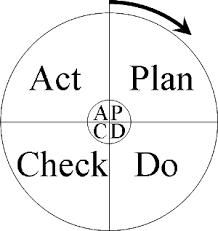

When I teach this "way to manage" process I also introduce the terms "MACRO" PDCA and "MICRO" PDCA... because I think its very important to company's and their employees to understand all the dynamics in this management process, some like to also refer to it as "small scale" or "large scale" PDCA, it all means the same in the eyes of the company as long as the employees are thinking through their daily work which should support the company's business goals.
A company's first step in implementing the PDCA management system is to understand what is happening within each step of the process. Proper planning is an essential element for successful implementation. Within the Japanese culture, in general, when they are given a year long project for example, they will immediately "plan" for 9 months of that year and implement for 3 months. On the other hand, some traditional cultures (like us Americans at times), could be given the same project and we would plan for 3 months and have a frustrating implementation for 9 months because we tend to jump to the answers(the how) first instead of the problem first (the what).
A company must understand "Why" and "What" they want to accomplish each year, set company business indicators to measure those accomplishments monthly, share those indicators with employees, and give the employees the resources and opportunities to solve daily issues which contribute to the overall business goals. This goes back to my first post in having a "line of sight". This concept is in essence what I'm referring to as MACRO PDCA (business level planning as a company) and MICRO PDCA (employees solving daily problems supporting the business goals). This visual can show the micro PDCA activities supporting the business. This I believe is a key factor in creating a culture driven towards continuous improvement.

Til next time,
Tracey Richardson
@tracey_san
Monday, February 2, 2009
What is the importance of "Jidoka" Building in Quality within your culture?
Often when I'm instructing at various companies I will ask the question. How do you ensure you are building "Quality" into the products you make? Are all your team members building the product with the "customer" in mind? Do team members understand how they are contributing to the companies goals when they build these products? These are all important questions to answer in regard to the strength of the "culture" within your company. How do you define Culture:
The basic philosophies that a given group has invented, discovered, or developed in learning to cope with arising issues that have worked well enough to be considered valid, and therefore, to be taught to new team members as the correct way to perceive, think, and feel in relation to those issues.
Does your company have a strong culture? Do your team members (employees) believe in the work standards and goals your company has? When it comes to Culture, Toyota isn't perfect but they do demonstrate a strong belief system within the team members better than most companies today.
These questions take us back to the basic philosophy Toyota has in regard to Standardized Work. Standardized work is present for every position on the production line. How is Standardized Work defined:
Record of best known method to perform work repeatedly and orderly in order to ensure production without waste
The Toyota Production System "house" (TPS) has 2 main pillars - Jidoka, Just-in-Time, and Standardization as the foundation of the house. Taichii Ohno often said "Without Standards there can be no Kaizen", hence the need for Standardized Work, and the foundation of what Toyota builds its production system on.
Where does your company rate in regard to Standardized Work development? Does your leadership see it as important? It's a foundational piece to Culture and continuous improvement that most overlook as a need for success.
Til next time,
@tracey_san
The basic philosophies that a given group has invented, discovered, or developed in learning to cope with arising issues that have worked well enough to be considered valid, and therefore, to be taught to new team members as the correct way to perceive, think, and feel in relation to those issues.
Does your company have a strong culture? Do your team members (employees) believe in the work standards and goals your company has? When it comes to Culture, Toyota isn't perfect but they do demonstrate a strong belief system within the team members better than most companies today.
These questions take us back to the basic philosophy Toyota has in regard to Standardized Work. Standardized work is present for every position on the production line. How is Standardized Work defined:
Record of best known method to perform work repeatedly and orderly in order to ensure production without waste
The Toyota Production System "house" (TPS) has 2 main pillars - Jidoka, Just-in-Time, and Standardization as the foundation of the house. Taichii Ohno often said "Without Standards there can be no Kaizen", hence the need for Standardized Work, and the foundation of what Toyota builds its production system on.
Where does your company rate in regard to Standardized Work development? Does your leadership see it as important? It's a foundational piece to Culture and continuous improvement that most overlook as a need for success.
Til next time,
@tracey_san
Friday, January 23, 2009
Why does Lean "Implementation" fail with most companies?
It has been my experience with companies that are trying to implement lean or change, is that one of the main reasons their "lean initiatives" fail is that TOP management feels its a "program" for the workers to try, and not necessarily a requirement at their level. Some management feel they may be exempt from the change because of their experience, time in grade, or an earned title within the company. This is a common belief and a major stumbling block for long term sustainability in a company trying to change its business practices.
When a company attempts to create a positive "culture"; lean thinking should be practiced by all levels (team member to the plant president). One of the keys to a successful transition is to ensure a company has "buy-in" from your team members doing the work, and that the company explains the "why" along with the "what".
By doing this the change it creates a "value-added'ness" (a Tracey word) to the team members doing the work and they are more apt to understand the bigger picture (company business plan) than not. It's easy for anyone to tell someone what to do, but explaining "why" it's important is often left aside. The "why" should be related to the Company's Key Performance Indicators (KPI's) i.e. Quality, Productivity, Safety, and Cost. I tend to call this the "Line of Sight". When a team member has a line of sight to what the company is trying to accomplish, then they have a better understanding of what is value-added and non-value added work (waste).
Till next post...
@tracey_san
Tracey Richardson
When a company attempts to create a positive "culture"; lean thinking should be practiced by all levels (team member to the plant president). One of the keys to a successful transition is to ensure a company has "buy-in" from your team members doing the work, and that the company explains the "why" along with the "what".
By doing this the change it creates a "value-added'ness" (a Tracey word) to the team members doing the work and they are more apt to understand the bigger picture (company business plan) than not. It's easy for anyone to tell someone what to do, but explaining "why" it's important is often left aside. The "why" should be related to the Company's Key Performance Indicators (KPI's) i.e. Quality, Productivity, Safety, and Cost. I tend to call this the "Line of Sight". When a team member has a line of sight to what the company is trying to accomplish, then they have a better understanding of what is value-added and non-value added work (waste).
Till next post...
@tracey_san
Tracey Richardson
Subscribe to:
Comments (Atom)